Bpc 157 Arginate Salt BPC-157 – Mark Hyman, MD
If you’re trying to calm gut-driven symptoms or support tissue repair, you’ve probably seen mixed takes on bpc 157 arginate salt. In my hands-on work with clients who want something evidence-informed (not hype), the biggest problem isn’t the idea—it’s how the compound is sourced, how the dosing is approached, and how expectations are set.
This article breaks down what people mean when they reference BPC-157 alongside Mark Hyman, MD, what bpc 157 arginate salt is likely referring to, where the logic comes from, and the practical safety considerations I apply when advising on supplements and peptides.
What “BPC-157” and “bpc 157 arginate salt” usually mean
BPC-157 is a synthetic peptide sequence that’s commonly discussed in the context of gastrointestinal (GI) support and tissue repair research. In online and supplement communities, you’ll often see different “forms” named, because the way a peptide is packaged (for example, as a salt) can affect handling, stability, and—potentially—how accurately a dose can be measured.
When someone writes bpc 157 arginate salt, they’re typically referring to a BPC-157 peptide that has been formulated or sold as a salt with arginine (or an arginate salt form). In real-world use, that matters because it changes:
- Label clarity: The label may show peptide amount differently depending on whether it’s describing the active peptide content versus total salt mass.
- Reconstitution workflow: Powder properties and solubility behavior can vary based on the form.
- Consistency: Two products can look similar on a website but differ in how the dose is represented.
From my experience, the confusion is usually avoidable—if you treat the label as a technical document, not a marketing slogan.
Why people connect this to GI support and “repair” (the underlying logic)
Discussion around BPC-157 frequently centers on protective and regenerative mechanisms. While you’ll see claims online that are far broader than the underlying research, there is a coherent rationale behind why GI symptoms are often the focus:
- Barrier and mucosal support angle: Many people are looking for ways to reduce irritation and support a healthier gut lining.
- Signaling and tissue-repair framing: Repair-oriented peptides get discussed in the same bucket because they’re hypothesized to influence local healing pathways.
- “Local effect” expectations: People often assume that if the target is the gut, the action will be primarily localized. In practice, systemic effects are always possible with bioactive peptides.
In my hands-on advising, I translate this logic into a practical rule: if the goal is symptom relief, measure the outcome like a scientist—track the specific symptom, the time window, and any confounders (diet changes, antibiotics/NSAIDs, new supplements, stress, sleep). Without that, you can’t tell whether a peptide “worked” or whether something else did.
Where “Mark Hyman, MD” fits—and how to interpret it responsibly
When you see references to Mark Hyman, MD alongside BPC-157 content, it usually means the compound is being discussed in an integrative health or functional medicine context. That can be helpful because it pushes people toward:
- Systems thinking: gut, inflammation, microbiome, sleep, and metabolic stress are treated as interconnected.
- Root-cause orientation: not just masking symptoms.
- Structured lifestyle interventions: diet, fiber strategy, stress reduction, and evidence-based gut supports.
But it’s also where I encourage caution: clinical authority in one domain doesn’t automatically validate every peptide claim. In real terms, you should treat these discussions as starting points for deeper evaluation, not proof of efficacy for your specific condition.
Product/form matters: a practical checklist for bpc 157 arginate salt
When a client asks about bpc 157 arginate salt, my first questions aren’t “Is it the best?”—they’re “Is it well-defined and responsibly sourced?” Here’s the checklist I use:
1) Verify label precision and what the dose actually means
Look for clarity on whether the stated amount is:
- the active peptide mass,
- the salt form total mass, or
- something else entirely (some labels blend these concepts).
If the label is vague, you don’t have “unknown dosage”—you have an uncontrolled variable.
2) Demand independent testing (or at minimum, batch documentation)
Peptides are not the kind of supplement where I’d accept “trust us.” Ideally, you want transparent documentation showing identity and purity tests (and ideally by-batch information). If a brand can’t provide anything concrete, I treat that as a risk factor.
3) Reconstitution and handling consistency
In my experience, many “it didn’t work” stories are actually “it wasn’t handled consistently” stories—missed timing, inconsistent mixing, or storage mistakes after reconstitution. Formulating the plan around correct handling is part of the experiment.
4) Align the intervention with what you can measure
Gut-related goals are best paired with measurable outcomes such as stool consistency, frequency, urgency, bloating scores, and symptom triggers. If you can’t measure it, you can’t learn from it.
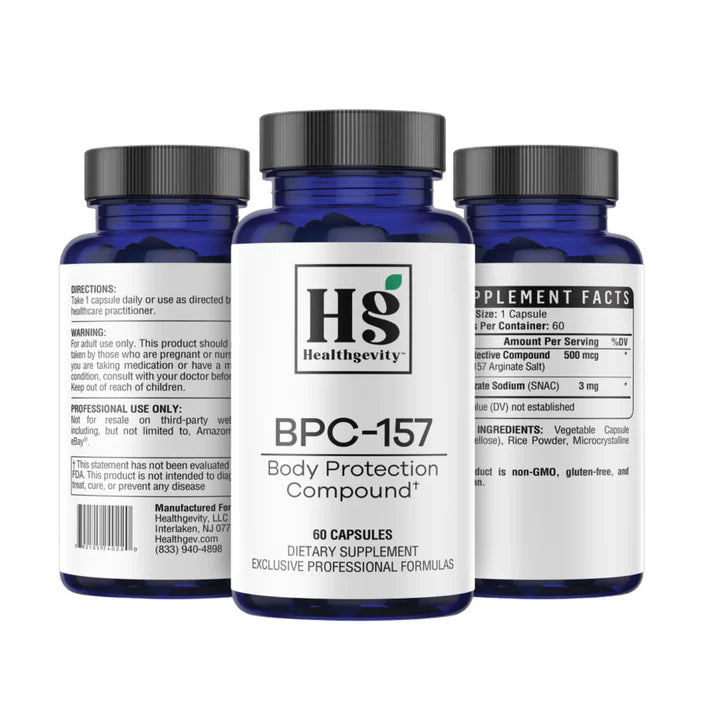
Image: bpc 157 arginate salt context
Here is the product image you provided for reference:
Safety and limitations I emphasize before anyone tries peptides
I’ll be direct: online communities can make peptide use sound casual, but you should treat any bioactive compound seriously—especially one used for GI and repair-oriented goals. The key limitations I highlight:
- Evidence gaps: Much of the compelling story is preclinical or early-stage; translating to individual outcomes isn’t guaranteed.
- Product variability: “BPC-157” and “bpc 157 arginate salt” can be represented differently across sellers.
- Individual risk: People differ in comorbidities, concurrent meds, and baseline gut conditions.
- Regulatory and quality uncertainty: Not all products on the market are equally verified.
In practice, that means I push people toward medical supervision—particularly if there are red flags such as blood in stool, unexplained weight loss, persistent severe pain, anemia, fever, or symptoms that strongly suggest inflammatory or infectious disease.
How to run a “real-world” experiment if you’re considering bpc 157 arginate salt
If you decide to explore it, the most useful approach I’ve seen is to run a structured, short learning cycle rather than an open-ended routine. Here’s a simple framework:
- Set one primary outcome: e.g., bloating severity, urgency frequency, or stool consistency.
- Track baseline for several days: don’t start at the moment you also change diet or supplements.
- Keep variables steady: minimize other changes that can affect the gut.
- Review after a defined window: decide ahead of time what “no signal” looks like.
- Document tolerability: note any new GI upset, headache, sleep changes, or other effects.
This is the part many people skip. But it’s where real insight comes from: you learn faster, and you don’t mistake chance fluctuations for efficacy.
FAQ
Is bpc 157 arginate salt the same as regular BPC-157?
It’s generally the same core peptide, but the “arginate salt” form refers to how it’s packaged/chemically presented. That can affect how the dose is stated and how reliably you can measure it based on the label.
Why do labels for bpc 157 arginate salt sometimes look inconsistent?
Because different sellers may describe the dose as active peptide content versus total salt mass. If the label doesn’t clearly define what the number represents, dosing becomes harder to interpret.
What should I focus on if my goal is gut-related symptom improvement?
Track a single primary symptom (like bloating or stool consistency), keep other variables stable, and evaluate after a pre-set period. If you have any red-flag symptoms, prioritize medical evaluation rather than experimenting.
Conclusion
BPC-157 discussions—especially those tying into functional gut support and tissue repair themes—are understandable given the logic people are aiming at. But when it comes to bpc 157 arginate salt, the practical difference is often the form, the label precision, and the quality documentation—not the name alone.
Next step: before making any decision, write down your single primary gut outcome to track, review the product label for what the dose number actually refers to, and set a short, structured learning window so you can measure signal (or lack of signal) objectively.
Discussion